Dev and his family: six rounds to give a brand a face
The rule that turned out to be the engine
dev-fran has a hard identity rule: on any public surface it is "Fran", and nothing more. No surname, no links to personal profiles. A brand guardian enforces it and blocks the publish when something slips through.
The consequence is not subtle. The brand cannot show the face of the person who runs it.
That reads like a limitation. It is the opposite. If I cannot be the face, the brand needs another one, and the one that shows up is the AI I direct — which happens to be exactly what I sell. The restriction was not something to work around. It was the brief.
This is the log of the day we built that face. Ninety-two images: six rounds of twelve proposals each, a seventh pass with six more, two spec sheets and the twelve scenes that tested them. The first three rounds were discarded whole. I am not cleaning it up, because the discarded rounds are the interesting half and because every correction that actually moved the needle was about what to ask for, never about the engine.
It did not start as a character
It started as an ad. I have a free study game for the Spanish recreational boating licence living at per.dev-fran.com, and the idea was to use it as an anchor: a short video you have to watch before you can play. My first draft of the script went something like this.
"Hi, what do you think of this digital experience? It was built very fast by dev-fran.com, where we do experiences and work with artificial intelligence to turn your next idea into a business, a website, an app — anything is possible."
Four things wrong with it, and all four are worth writing down because they are not specific to me.
"Anything is possible" is the least memorable thing a sentence can say; without specificity there is no recall. "We do" is an imperial plural for a brand that is one person and a method. "Built very fast" is a number with no number in it. And the expensive one: it asks before it gives. You stopped somebody who wanted to play, and the first thing they get is your catalogue.
There is a frame underneath all four. Whoever watches that video is unaware on Schwartz's scale of awareness. They are studying for a nautical exam. They do not know they have a digital problem. Naming the product to an audience in that state does not convert them, it expels them. The right KPI for that video is not the click. It is being remembered.
I stopped writing the script and went one level down: the brand has no real identity. Without a spokesperson there is no video, and a spokesperson is a brand decision, not a piece-level one.
Why we could not copy HeyMark
The reference I had in mind was HeyMark: "the marketing team you always wanted, now with Mark." Mark is an AI character who is both mascot and conversational assistant. Write to him and he does your marketing.
It works, and it could not be copied. Mark can be the spokesperson because Mark is the product. dev-fran does not sell that. It sells an engineer's judgement applied with AI at every stage. A synthetic spokesperson implying the AI does the work on its own contradicts both pillars of the brand at once.
So the constraint got sharper: the character cannot be the one who does the work. It has to be the one who shows it.
Round 1: the dot
The hypothesis was that the avatar was already latent in the wordmark. The design system says, in writing, that the dot means "the AI inside" and the marker stroke means "the engineer's hand on top." That is a two-actor cast nobody had read as a cast. Fran is the hand, the dot is the AI.
Twelve variations, from a bare dot with glasses to a head with features.
The verdict was blunt: all bad. It has to be humanised — a character, not a dot with glasses. It has to have expressions, talk, smile.
Two lessons, both of them useful.
A dot cannot act. The coherence with the wordmark was irresistible on paper and worth nothing in practice, because the character's job is comedy.
And an enlarged iris stops being a brand and becomes an emoji. The dot works in the wordmark because it is eight pixels wide: at that scale the colour organises. Blown up to a whole character, the same gradient paints a surface, which is precisely what the brand's own standard forbids. The result reads like a messaging sticker. It was the look we had just retired coming back in through the window.
Round 2: humans in 3D
Correction applied: twelve full-body 3D characters in different styles — studio animation, clay, vinyl, low poly, cel shaded, paper, felt.
They came out well. One of them brought a finding that survived everything else: the colour orb ended up resting in the open palm instead of floating alongside. Without a word of copy, that establishes the relationship. He handles the AI. He is not the AI.
The verdict was still no. Not a clay human — an animated character, created from scratch.
The lesson: I had skipped over the place where every memorable character actually lives. I went from an abstract dot straight to a person wearing clothes. Baymax, Wall-E, Eve, the Minions — not one of them is human and not one of them is abstract. They are original creatures with invented anatomy.
Round 3: original creatures
Twelve creatures with anatomy of their own: a capsule with legs, an inflatable, a lighthouse lantern, an egg, a visor, a droplet, a robot, plush, modular, origami, a cloud, a cable.
Two more corrections came with this round. The first: stop personifying the dot. The second changed the delivery format permanently — show me images doing different things so I can choose.
From that point on, every proposal was a sheet of four actions — walking, cooking, explaining, fed up — instead of a pose. A nice pose tells you nothing about whether a character can act. That single change to the deliverable is what made the remaining rounds decidable.
Two of these were genuinely good. The egg, which was the cleanest thing in the batch. And the visor: a screen for a face with physical glasses on top of it, which is the joke of an AI that needs corrective lenses. The visor also had a real technical advantage — a graphic face is infinitely easier to reproduce identically than a modelled one.
The verdict killed both: the egg has no personality, and the other one has personality but putting the face on a screen means you get no human expressions, no teeth, no eyebrows.
That is the trade I had made without noticing. I bought consistency and paid for it with acting. Bad deal for a character whose job is comedy.
Round 4: creatures with a face made of flesh
The missing territory was Inside Out and Monsters Inc. Creatures that are not human but have a complete face: eyelids, eyebrows that move independently, a mouth with teeth and a tongue.
The first one is Dev. The verdict on the batch: make variations of the little monster, with colours, but he has to look more like he works.
Round 5: colour and craft
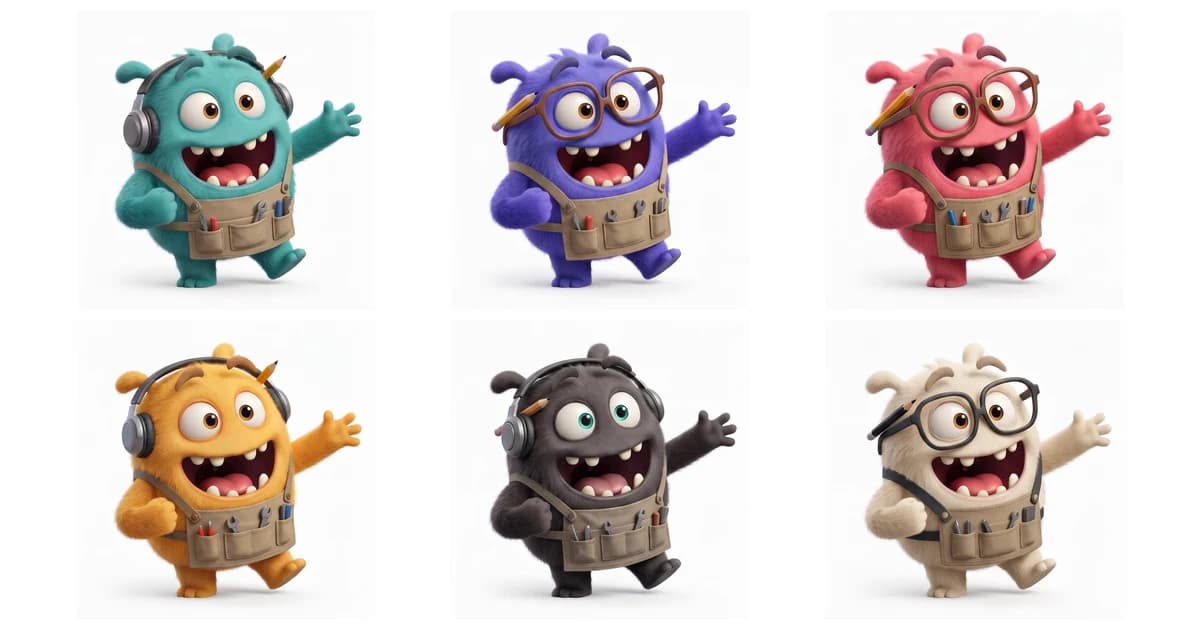
Twelve variations of the same creature, all generated by passing the winning image in as a character reference so it would be the same animal and not twelve lookalikes. Six of colour, six of work kit. And the four actions changed to push the "worker" idea: carrying things, typing, explaining, fused with a coffee mug.
The pick was the turquoise one with headphones. Headphones and a mug say long session; overalls say building site. The brand is the long session.
Round 6: how do you make him read as a machine?
This was the question that mattered, and it was aimed at the real problem: fur says living creature, which is the exact opposite of AI. A furry animal in an apron looks like a likeable labourer, not an engine.
Twelve tests of different devices: fibre optics, a watchmaker's loupe, a core in the chest, real antennas, data eyes, circuitry in the skin, a cable for a tail, orbiting particles, a forearm panel, inner light, a precision visor, and all of it at once.
Two of them worked. Fibre-optic fur, where every strand conducts light and colour pulses travel through it when he thinks — adorable and unmistakably synthetic, and nobody else has that trait. And the watchmaker's loupe flipped down over one lens, which says precision and small scale better than any tool would.
Then something showed up that nobody asked for. In the "exhausted" panel, the light in the fur came out off. Which means brightness works as an energy gauge: he lights up when he gets excited and goes dark when he is burnt out. That is free acting in every single shot, and it appeared on its own. The job was to notice it and promote it to a rule.
We also ran a seventh pass: a synthesis of the two winners, graphite plus fibre optics, because light reads far better over dark fur. It is still an open option.
The spec sheet: what stops him from drifting
With the character chosen, the urgent problem changed. It was no longer what does he look like but how do we stop him deforming.
Dev is going to appear in dozens of separately generated scenes, and drift between generations is how these projects rot. The character in shot five is no longer the character in shot one. It is not hypothetical: the defect showed up during the rounds. His eye colour changed between panels — brown, amber, green. In the graphite variant above, they came out green. In three of the colour variants his glasses simply left.
There is no clever fix. There are two boring ones, and they work.
Write the sheet with exact values, and copy them literally into every prompt. Turquoise #2ED3C6 fur. Warm amber-brown iris, and this colour never changes. Thick, dark turquoise eyebrows, independent, because they carry the acting. Two blunt bottom fangs always visible. Thick tortoiseshell frames. Over-ear headphones in dark graphite. No clothes.
And pass an approved image in as a reference on every single generation.
Then produce the two sheets that make the rule enforceable: a turnaround and an expression sheet.
Twelve scenes: the actual test
A spec sheet you never test is a document. So: twelve scenes generated separately, in situations with nothing in common. To camera, showing a website, cooking, at the helm of a sailboat, teaching a buoy, soldering, asleep on the keyboard, in a wall of monitors, pointing at a chart, sceptical at his phone, fused with a coffee, and celebrating.
It is the same animal in all twelve. That is the validation that the sheet works, and it is also the asset bank: those twelve shots cover most of what a short video needs without generating anything new.
Who Dev is
The name was already written in the wordmark, and it is the finding the whole thing hangs on.
dev-fran is Dev plus Fran. The AI in front, the engineer behind, separated by a hyphen since day one. He is Dev, and Devie to friends. Which gives us a punchline that has been sitting in every piece the brand ever published: look at the name. Dev-fran. I go first.
The running joke is that Dev insists he is the only one who works. He talks to Chaty GPT, to Claudio, coordinates every model, and at the end of the day somebody changes one of his decisions. Fran is the serious engineer in the back; Dev is the face.
That joke has a dangerous edge, and it needs a rule to stay safe.
Dev is brilliant, extremely fast, and without direction he does absolutely anything.
If Dev were infallible, the joke flips over and the person watching concludes "then I'll just use ChatGPT and skip the guy." Every punchline has to show that speed without judgement produces fast garbage. Dev delivers ten versions in a minute, Fran picks the one that works, Dev grumbles — and the one that got picked was the right one.
That way the humour demonstrates the differentiator instead of reciting it.
There was one more reference worth chasing: the talking-organs format, those 3D animated organs that explain your health, millions of views on Shorts and TikTok, produced with the same engines used here. It works through two mechanisms, and only one of them is obvious. The first is authority from the inside — "I'm your liver, I know what you did." Nobody argues with the organ. The second is that the organs argue with each other. That is the comedic engine, not the monologue. One organ explaining is an educational video; two of them fighting is entertainment.
Which has a design consequence: a spokesperson alone talking to camera runs out fast. Dev needs a cast.
The family
Here is where the colour variations stopped being alternatives. They are not discards, they are the casting. Dev is not an only child.
And a second finding of exactly the same kind as the name showed up. The siblings' colours are precisely the four aurora colours that rotate inside the dot in the wordmark. There was no family to invent and nothing to justify: it was already drawn in the logo. Just as dev-fran had been saying Dev plus Fran, the dot had been saying how many of them there were.
The trades came from watching them walk. The graphite one walks angry, so he is the one who fixes what was done badly. The pink one thinks, analyses, looks at the numbers and gets annoyed when they do not add up. The violet one is the one trying to understand the client, the project, the user, before anything gets built. And Dev coordinates everybody.
| Who | Colour | What they do |
|---|---|---|
| Vio | Violet #6D5BFF | Understands it before it gets built. |
| Dev | Turquoise #2ED3C6 | Builds, and coordinates the rest. |
| Numa | Pink #FF6B9A | Measures, and says so when the numbers do not work. |
| Tuerca | Graphite | Keeps what works running, fixes what does not. |
The names are Spanish words that already mean the trade, in the same office-nickname register as Dev, Claudio and Chaty GPT. Vio is the past tense of to see: the one who saw what nobody looked at. Numa comes from número. Tuerca literally means the nut in nuts-and-bolts, and it is what you call the person who gets their hands in and sorts it out.
The order is not the aurora's and it is not seniority. It is the life cycle of a project — understand, build, measure, keep alive. With that, the family stops being four personalities and becomes the offer told as a cast. Tuerca is maintenance, which is how the work gets billed.
There is one exception, and it is the best part. Three siblings come out of the dot. Tuerca does not: he is the colour of ink. Instead of being a problem, that is his punchline — the three of us are the colours that rotate; he is the colour you cross things out with. The one who did not come from the dot is precisely the one who handles what nobody planned for.
Amber was left without a sibling on purpose. Four sharp characters beat five lukewarm ones, and the fifth candidate trade is already Dev's. The colour stays in reserve: if it is ever needed, the sheet gets repainted.
The four of them live, introduce themselves and tell their own version of this on Dev's page.
Seven things I am taking to the next character
A brand restriction can be the creative engine. Not being able to show the owner's face was not solved in spite of the rule. It was solved by using it.
The right answer usually sits between two extremes. Abstract cannot act; human is not a character. The good territory was in the middle, and I had to fail at both edges to find it.
Every correction from the person deciding moved more than any technical iteration. The four were: a character, not a dot; a creature, not a human; a face of flesh, not a screen; and show it to me doing things. Not one of them was about the engine. All of them were about what to ask for.
A sheet of actions says more than a pose. Changing the deliverable from a portrait to four panels is what made it possible to judge whether the character could act. If your reviewer cannot decide, look at what you are handing them before you look at what you are generating.
Against drift: a written sheet plus a reference image. There is no magic. There is discipline. And the defects tell you when discipline lapsed — the green eyes and the missing glasses in this article are exactly that.
Sometimes the best thing appears on its own, and the job is noticing. The fur going dark when he is exhausted was never in a prompt. It came out, got spotted, and got promoted to a character rule.
Character first, brand second. A character that works can be repainted. A bad one in the correct palette is still a bad one.
The video that started all this still does not exist. But the premise changed: Dev does not have to be a toll you pay before playing. He can teach you buoyage and introduce the brand in the same breath — which is the only version of that video anybody would actually want to watch.