Content
Your product on video — no shoot, no model, no studio.
Vertical pieces, ready for your social feeds and your ads: someone telling something to camera, your product in motion, your app from the inside. Everything below was produced for real client campaigns. The machine gives you ten versions in a minute; the work is knowing which of the ten is the one.
The work
Three businesses, three different things to show.
A software product that needs explaining, a clothing shop that doesn't want a model, an app that sells by showing its insides. See which one looks like yours. Each one reached production with its whole process on record: the discards, the client's corrections and why what won, won.
Person to camera
For when what you sell needs explaining. Someone tells it in first person and the subtitle follows the voice word by word. It's the format that works best with people who don't know you yet, and the easiest to ruin: if the voice doesn't sound like a person, it shows in two seconds.
Cliencer · 37 s
see the logThe garment, with nobody in it
The owner doesn't want a model on the homepage — with a person in the shot, the clothes stop being what you look at. Each garment from the real catalogue was animated from its product photo as a museum piece: black background, one spotlight, the fabric breathing. No people and no voice.
Auba Oversize Style · 5 s · proposed homepage video, awaiting the owner's sign-off
see the logAn ad with the real product inside it
What's generated is the world around it; the app screen is the real one, captured from the product. This is version 6 — the five before it are in the log, each with the reason it changed.
Cliencer · Spain campaign · 30 s
see the logWhy the second piece is cheap
What the first piece costs, and what the fifth costs.
Your brand's face, voice and rules are built once. The first piece is where all the work happens: finding the face, choosing the voice among several, fixing how the subtitle looks and deciding what can be said and what can't. That gets saved under your name and every new video starts from there. That's why a four-piece campaign doesn't cost four times the first one.
The character
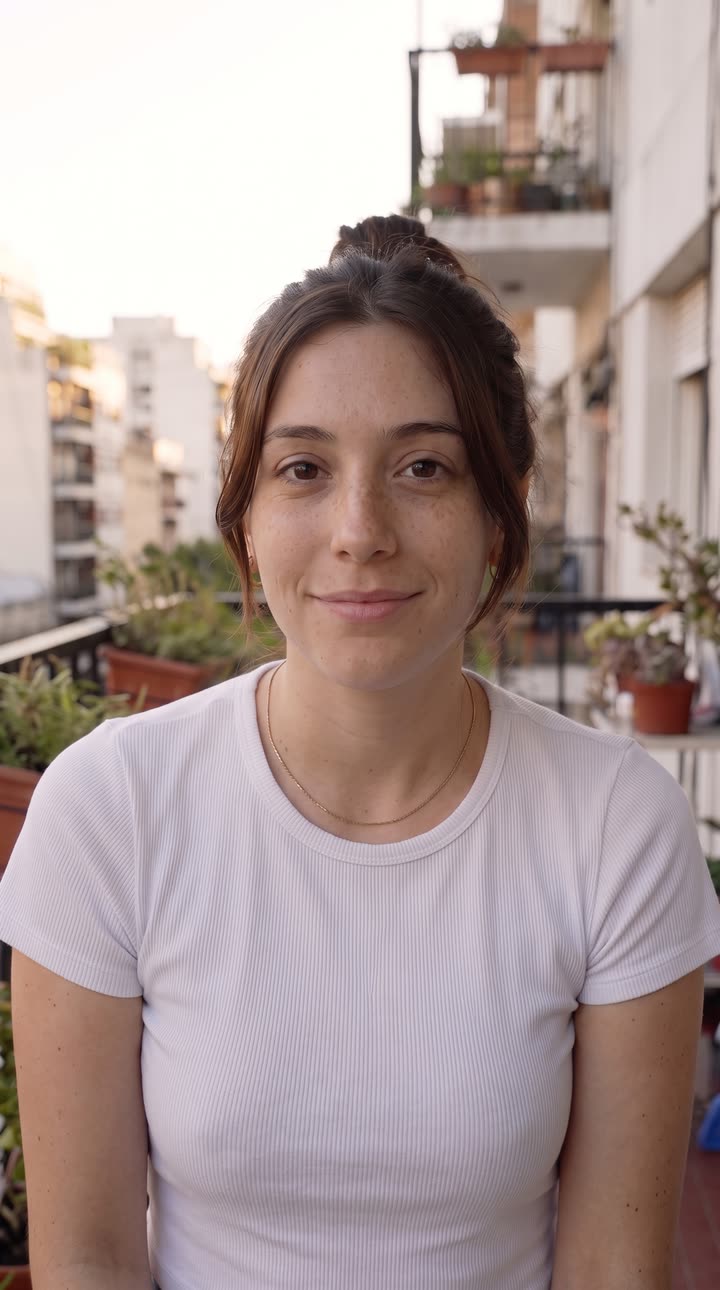
Before the video there's a photo. The face is generated once as a still — the one on the left — and the video comes off it: the generator animates that image, it doesn't invent a new one. The file gets saved, so every new shot in the campaign starts from the same face. The place, the script and the framing change; the person doesn't. And she doesn't exist.
Dar+ Sonrisas · braces campaign · 22 s
The voice
It's chosen by ear: the same text read by each candidate. The winner is saved with her exact settings, and the chosen take is archived as is — generated again, it would come out different. Listen to all four with the same text.
«Me pasé cuatro años diciendo: el año que viene empiezo con los brackets».
Four of the six candidates tested for this campaign, reading exactly the same text. The takes are in Spanish because that's the campaign's market.
The brief
The brand's typeface, its colour, the subtitle that highlights the word being spoken, and the rules about what can't be shown. It runs off code rather than by eye: change the text and everything else stays exactly where it was.
This one came back with the voice stumbling over a phrase — it sounded like a stutter. It wasn't the configuration, it was the text: a pair of quotation marks the voice read as a change of tone. The text was fixed and it went back up the same day.
This brand's spokesperson came out of here. The turquoise creature that may have brought you to this page has its sheet written down: the frame of the glasses, the exact amber of the iris, the three things it has to wear to still be itself six weeks later. Its three siblings are the same sheet repainted. If you liked how it looks, that is the service. Its whole story is in About me.
The test
Four models, one photo, one prompt.
Video generators do very well until you ask for fine detail on something that moves fast. A laughing mouth is the worst case, and with braces on top half of them give up: the teeth turn into a smear. In an orthodontics campaign that kills the whole clip, because the smile is the product. I couldn't find any public test that measured this, so I gave the same brief to four models and went through them frame by frame.
Braces hold in every frame, and the face stays the same person from start to finish.
USD 0,61 · 4 s
Braces fine. It tends to duck the head while laughing, which you can fix by asking.
USD 0,67 · 4 s
Braces fine, and the most expressive movement of the four.
USD 0,78 · 4 s
The braces smear right at the peak of the laugh. It's the cheapest of the four, which is exactly why it's worth knowing beforehand.
USD 0,39 · 5 s
First generation from each model, no editing and no cherry-picking: the same starting image, the same instructions, the same quality. Testing all four cost less than two and a half dollars. Choosing wrong costs the campaign that falls apart when the clip comes back broken.
How it works
Four steps, and the first two are your call.
The order isn't arbitrary: the cheap things get approved before the expensive ones. A script is rewritten in minutes; a video shot the wrong way has already been paid for.
Concept and script
What the piece says and in which exact words. This is where you decide what your customer is really weighing at the moment they choose. You sign it off before a cent goes into imagery.
The voice
Several candidates read your script and you pick by ear. It's the cheapest step and the one where judgement shows most: an unconvincing voice sinks a video that cost twenty times more.
Image and video
Only here does the pay-per-second part come in. First the face is fixed, then the shots come out, and each shot uses the generator that can handle what that shot asks for — not the usual one.
Edit and check
Subtitles from code, music where it earns its place, and a frame-by-frame pass hunting for odd hands, broken textures and jumps. A human does the checking: a video can look fine at full speed and still hide three broken frames.
What you get
- The finished vertical video, ready to post on your feeds or run as ads.
- The script and the voice as separate files, to reuse wherever you like.
- The character and the brief, locked: the next piece starts from there.
- The variants to test, and the log recording what was tested and how it went.
The first conversation is to see whether it makes sense at all. If it does, the piece or the campaign gets defined and quoted in writing before anything is produced. Content is separate from the monthly maintenance: it's not a fee, it's agreed when needed.
The limits
What I won't do with this.
This isn't a list of principles: it's what producing taught me, and every point has a date in some log.
First-person testimonials with a generated face and voice. An "I did this myself" from someone who doesn't exist gets spotted, and the backlash lands on the client's brand. You can imply it without lying: the person who lived it is always a third party.
Treatment results presented as if they belonged to a real patient. In healthcare that's exactly what gets scrutinised, and an image can't be walked back with a caption underneath.
Hiding that it's AI. The label goes on the piece. What's being sold is that it's well directed, not that it fools anyone.
Bring me something you want to show.
A product, a service, an idea that today takes a paragraph to explain and would land better in thirty seconds. The first conversation is about whether it's worth doing at all, not about selling you a campaign.